
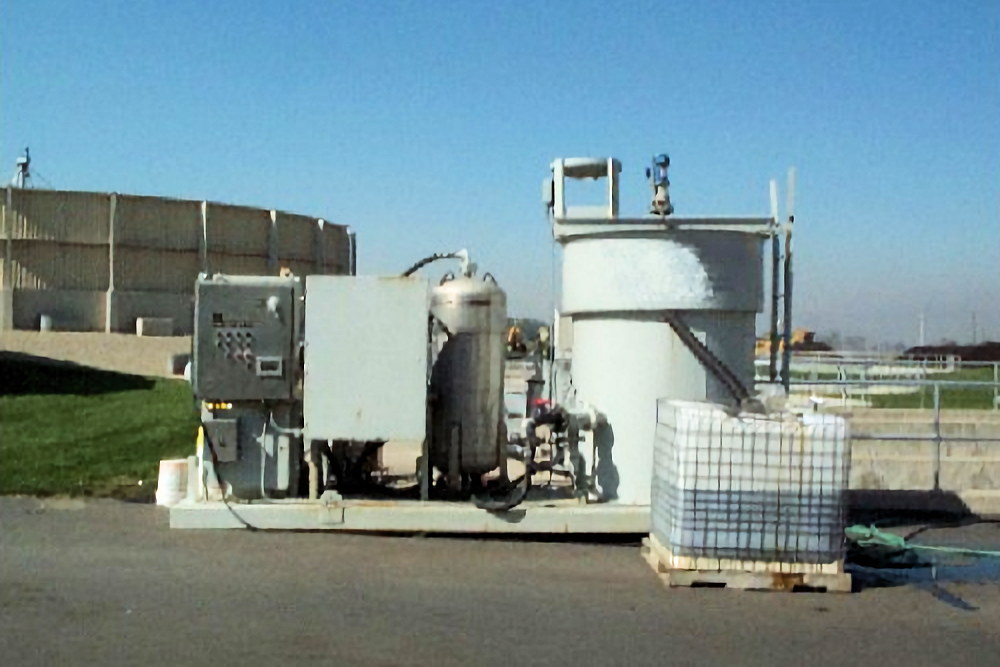
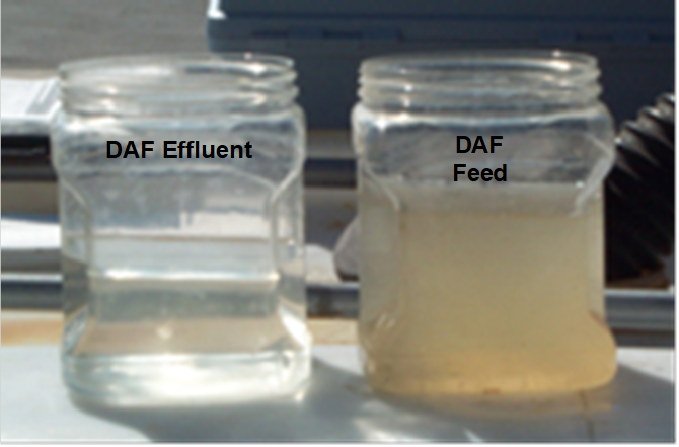
Pilot-scale dissolved air flotation (DAF) testing demonstrated that effluent suspended solids removal in excess of 82% (<20 mg/L) can be achieved with chemical conditioning and approximately 72% (~35 mg/L) without chemical addition. These results indicate that high-efficiency clarification is possible even under non-chemically assisted conditions.
Because the DAF effluent discharges directly to sand filtration, improved effluent clarity is expected to significantly reduce backwash frequency. Reduced backwashing lowers downtime, minimizes media loss, and decreases labor requirements.
Equally important, the DAF system consistently generated float solids concentrations of approximately 4 wt%, substantially higher than conventional clarification systems.
Pilot Test Performance Summary
Across multiple pilot runs conducted at a saturation pressure of 70 psig:
- Average feed TSS: ~97 mg/L
- Effluent TSS with chemicals: <10 mg/L achievable
- Effluent TSS without chemicals: <35 mg/L achievable
- Removal efficiencies frequently exceeded 80%
- 100% recycle provided the most consistent performance
- Float solids concentration: 4–5 wt%
Chemical addition (coagulant and polymer) improved particle destabilization and effluent clarity, though acceptable results were also obtained without chemicals.
Process Impact on Downstream Operations
1. Reduced Sand Filter Loading
Improved DAF effluent quality directly reduces suspended solids loading to downstream sand filters. A 50% reduction in backwash cycles is considered achievable under the tested operating conditions.
Benefits include:
- Reduced power consumption
- Lower labor requirements
- Decreased media wear and replacement
- Increased system uptime
2. Improved Anaerobic Digester Performance
DAF increases sludge concentration from typical values of 1.5–2.0 wt% up to 4–5 wt%.
This higher solids concentration:
- Reduces hydraulic loading to digesters
- Improves volatile solids reduction efficiency
- Enhances BOD reduction
- Decreases pumping requirements
- Reduces belt press runtime
Concentrated sludge improves overall digester stability and performance.
Estimated Annual Operational Savings
A conservative cost analysis identified savings in the following areas:
Sand Filter Labor Reduction
Estimated annual savings: $320
Backwash Pump Energy Reduction
Estimated annual savings: $4,082
Transfer Pump Energy Reduction
Estimated annual savings: $4,082
Belt Press Operation Reduction
Estimated annual savings: $12,480
Total Estimated Annual Savings: $20,965
These savings exclude additional long-term benefits such as reduced equipment wear, lower maintenance frequency, and improved digester gas production.
DAF System Sizing and Design Basis
Based on pilot testing:
- Design flow: 3,473 gpm (5 MGD)
- Hydraulic loading rate: 2.0 gpm/ft²
- Required surface area: 3,473 ft²
- Air-to-solids ratio (tested basis): 0.87 at 100% recycle
Although typical air-to-solids ratios are significantly lower in conventional systems, pilot testing demonstrated superior performance at higher recycle rates.
The corresponding solids loading rate was approximately 0.05 lb/hr/ft², which is within acceptable design limits for waste activated sludge applications.
Implementation Options
Two implementation strategies are commonly evaluated in facilities considering DAF conversion:
Option 1: Retrofit Existing Secondary Clarifiers
Advantages:
- Lower capital cost compared to new construction
- Utilizes existing tankage
- Minimal footprint expansion
- Reduced permitting complexity
This approach converts existing clarifier basins into DAF units designed at 2.0 gpm/ft².
Option 2: Install New DAF Unit
Based on the design criteria:
- 67-ft diameter DAF unit required
- 100% recycle operation
- Capable of achieving:
- <10 mg/L effluent TSS (with chemicals)
- <35 mg/L effluent TSS (without chemicals)
Chemical make-down systems for coagulant and polymer are recommended to provide operational flexibility and optimize effluent clarity.
Additional Operational Recommendations
To maximize performance, facilities should consider:
- Evaluating DAF for waste activated sludge from trickling filters
- Managing filter sloughing carefully to prevent nutrient removal disruption
- Maintaining consistent underflow pumping to reduce turbulence
- Monitoring Sludge Volume Index (SVI) for compaction control
- Evaluating chemical optimization strategies in primary and secondary clarification
If SVI remains below 150, chemical usage may potentially be reduced or eliminated.
Summary
Pilot-scale testing demonstrates that dissolved air flotation:
- Achieves >80% solids removal with chemical conditioning
- Produces effluent TSS <10 mg/L when optimized
- Achieves ~35 mg/L without chemicals
- Increases sludge concentration to >4 wt%
- Reduces downstream filter loading
- Improves digester performance
- Generates estimated annual savings exceeding $20,000
DAF technology offers a technically sound and economically attractive alternative to conventional secondary clarification for waste activated sludge treatment.